Love Across Generations
The Wisdom Couples Need When Age Gaps Exist

Love has a remarkable way of bringing two people together. It can cross cultures, backgrounds, personalities—and sometimes even generations. But while love can create a connection, wisdom is what sustains a marriage.
Age gaps in relationships are not automatically wrong. Throughout history, many couples with significant age differences have built meaningful lives together. Yet such relationships often raise important questions that couples must thoughtfully consider before committing to a lifelong partnership.
Marriage is not sustained by affection alone. It is built on the ability of two people to journey through life together across many seasons.
When two people come from the same generation, they often share an unspoken understanding of the world around them. They grew up under similar cultural influences, experienced similar social environments, and formed expectations about work, family, and life progression within the same era.
These shared experiences shape how people communicate, how they solve problems, and how they imagine the future.
When the generational gap is wider, those shared reference points become fewer.
One partner may still be in a season of exploration—building a career, discovering identity, and expanding possibilities—while the other may already be thinking about stability, legacy, or even slowing down. One may be entering the most energetic years of life, while the other may already have lived through many of those defining stages.
These differences do not make love impossible. But they can make alignment more challenging.
Marriage thrives on alignment.
Alignment in vision.
Alignment in energy.
Alignment in the stage of life that two people are walking through together.
When couples are navigating very different life stages, tension can quietly develop over time. Expectations about lifestyle, finances, family planning, social life, and long-term goals may begin to diverge.
What feels natural or timely to one partner may feel premature—or delayed—to the other.
This is why wisdom encourages people to look beyond attraction when choosing a spouse.
A sustainable marriage is not built only on how two people feel about each other today; it is built on whether their lives can move forward together tomorrow.
For singles, this reflection is an invitation to slow down and consider the bigger picture. Attraction and compatibility are important, but it is equally important to ask whether two people are truly positioned to grow in harmony.
One helpful question to ask is:
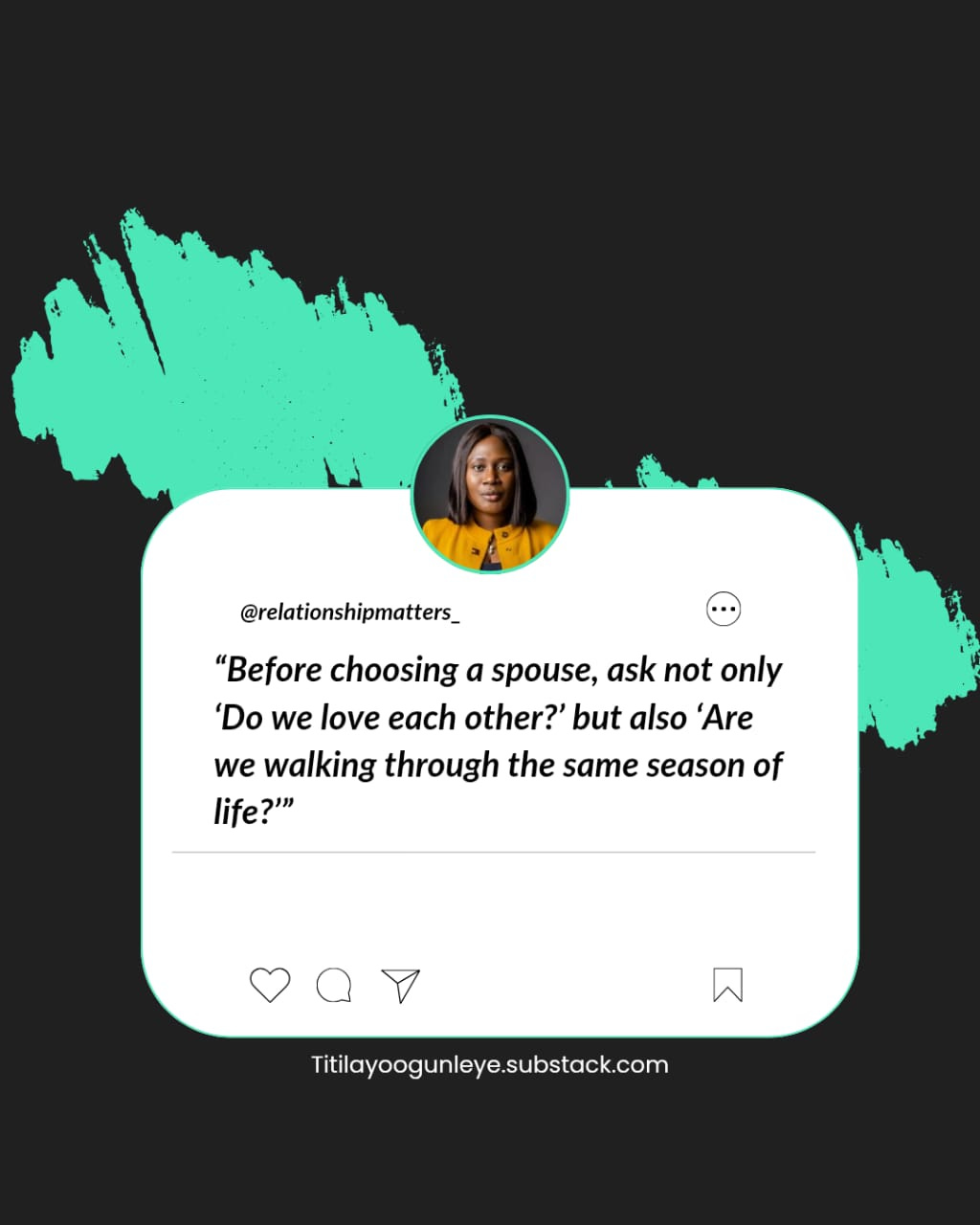
“Before choosing a spouse, ask not only ‘Do we love each other?’ but also ‘Are we walking through the same season of life?’”
For couples who are already married with an age gap, this reflection should not bring discouragement but awareness. Many marriages with age differences thrive when both partners intentionally cultivate understanding, patience, and mutual respect.
In such relationships, honest communication becomes especially important. Conversations about expectations, energy levels, family goals, and long-term plans help couples navigate potential differences with wisdom rather than frustration.
The goal of marriage is not merely to love each other.
The goal is to walk through life together in unity.
Love may spark the beginning of a relationship, but a long-term partnership requires something deeper: shared rhythm, shared direction, and the ability to move through life at a similar pace.
Sometimes the difference between a relationship that simply survives and a marriage that truly flourishes lies in how well two people can journey through life side by side—growing, building, and evolving together over the decades.
Because while love may bring two people together, shared rhythm and shared direction often determine whether that union can thrive for a lifetime.